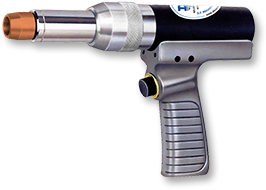
| D/F Air-Cooled MAC/MAT 400 MIG Torches - Remote Mount |
![]()
D/F Air-Cooled MAC/MAT Series 400 MIG TorchThe Air-Cooled Series 400 Machine Barrels are readily adaptable to mechanized or robotic welding and are available in the standard length of 12-5/8". The models MAC and MAT are furnished completely assembled and ready for installation. Both models have the feature of individual replaceable service connections with a removable cable/hose sheath to add to the durability and long life of the barrel assemblies. Remote mounting is accomplished by an insulated mounting bracket and utilizing a casing/conduit and an adapter to the wire drive. Throughout the years, Lincoln Electric used D/F Machine Specialties MIG and TIG torches exclusively on FANUC robots. The typical robotic cell included the Fanuc ArcMate 100 robot models and the Lincoln Powerwave 450 power supply. Check out the D/F Machine Specialties MAC-5 17811 Air-Cooled Barrel welding 3/64" Aluminum on the BUG-O Systems CWE-5. The CW-5 Circle Welder with Remote Control is designed for single or multipass welding of couplings or nozzles on pipe and vessels utilizing MIG or Flux Core process, with gas shield. The machine is equipped with its own wire feeder, rotation drive motor, rise and fall cam assembly and welding gun. Horizontal and vertical racking to position the torch and a 30 lb (14 kg) spool holder. OTC Daihen is providing the DP400 power source and CMRE-741 4-roll wire feeder. MODEL EXPLANATION FEATURES
![]()
D/F Air-Cooled MAC/MAT Series 400 Short MIG TorchThe Air-Cooled Series 400 Short Machine Barrels are readily adaptable to mechanized or robotic welding and are available in the 9-5/8" length. The models MAC and MAT are furnished completely assembled and ready for installation. Both models have the feature of individual replaceable service connections with a removable cable/hose sheath to add to the durability and long life of the barrel assemblies. Remote mounting is accomplished by an insulated mounting bracket and utilizing a casing/conduit and an adapter to the wire drive. Throughout the years, Lincoln Electric used D/F Machine Specialties MIG and TIG torches exclusively on FANUC robots. The typical robotic cell included the Fanuc ArcMate 100 robot models and the Lincoln Powerwave 450 power supply. MODEL EXPLANATION FEATURES
Robotic Welding SystemsRobotic welding is suitable for any welding process designed for automation in that it requires repetitive tasks on similar pieces. Robotic welding also works well when there are welds on more than one axis, or where access to the pieces is difficult. When programmed, robots perform the same welds every time on workpieces of the same dimensions and specifications. In about 80 percent of applications, robotic welding is used with the solid wire GMAW process. Throughout the years, D/F Machine Specialties’ MIG & TIG torches were used exclusively on the following FANUC Robotics System 100 Models - ArcMate 100, ArcMate 100i, ArcMate 100iB, and ArcMate 100iB/6S. The typical power source used with the D/F Torches on the Fanuc robotic cell was a Lincoln Powerwave 450 power supply. QUALITY: Higher quality welds are maintained with the mechanical consistency of the robot. Consistency is provided by the precise movement of the robot arm and torch, as well as the wire feed speed and travel speed. Robotic welding creates a more consistent weld strength and better weld appearance. PRODUCTION COSTS: Robotic Welding reduces productions costs by using fewer welding consumables and producing fewer scrapped parts. RETURN ON INVESTMENT: The ROI for an industrial welding robot usually appears after about 6 months. Increased productivity, decreased labor, and many other benefits of automated welding factor into faster ROI times. PRODUCTIVITY: The repeatability and speed of the robotic welding system provides increased productivity. Robotic welding can produce at a higher rate than human welding, and allow for a more productive workforce. SAFETY: Employers find that they have fewer employee accidents and lower Workers Comp claims when they change to robotic welding. There are two popular types of industrial welding robots, articulating robots and rectilinear robots. Robotics control the movement in each of these robot types by rotating a wrist in space. These two types are defined as follows: 1. Rectilinear robots move in line in any of three axes (X, Y, Z). In addition to linear movement of the robot along axes there is a wrist attached to the robot to allow rotational movement. This creates a robotic working zone that is box shaped. 2. Articulating robots employ arms and rotating joints. These robots move like a human arm with a rotating wrist at the end. This creates an irregularly shaped robotic working zone. Most articulated welding robots feature six axes and function as part of a robotic system or workcell. Robotic welding systems reduce production costs and improve quality with consistency and repeatability. Consistency is provided by the precise movement of the robot arm and torch, as well as the wire feed speed and travel speed. The repeatability of the welding robotic system provides increased productivity. To create a successful robotic welding system, you need an integrator who can properly design a program that integrates the parts to be welded and the robotic cell and tooling. Robotic welding is simpler than one might think, but it requires precise measurements and an understanding of parameters of the equipment. It is important to team with an integrator with the experience and customer service demanded by your robotic needs. Benefits of Robotic Welding:
Things to consider before beginning a new robotic welding project:
Benefits:
Features:
Options:
Note: ARC Mate is a registered Trademark of FANUC LTD. FANUC Ferris Wheel System - The FANUC Ferris Wheel Workcell is designed to save space and enhance operator safety. FANUC Gantry System - A gantry robot system mounts a robot arm on an overhead track, creating a horizontal plane that the robot can travel and extending the work envelope. FANUC Manual Turntable System - A FANUC workcell with a manual turntable is an ideal solution for applications that require loading and unloading parts while the robot is in operation. FANUC Stationary Table System - FANUC robots offer excellent ROI in welding and handling applications. Realize incredible savings with a FANUC turnkey workcell that includes a single or dual stationary work table. FANUC Track System - The Dual FANUC Track System allows for nearly 63 feet of travel along a servo controlled track to accommodate applications with large parts and multiple processes. FANUC Turntable System - Order a workcell that fits your needs! Available in any size, this workcell pairs a 180 degree table with one or two FANUC robot arms for maximum productivity. Fanuc - Intelligent Robot Solutions Application: Arc Welding Challenges: The company was producing about 18,000 wheelchairs per year, and according to the director of operations, “It didn't take long for us to realize that we needed to find a better method to meet production goals.” Solution: The integrator selected Lincoln Electric and FANUC Robotics to develop a robotic arc welding system to weld mild-steel wheelchair side frames and foot rests. The solution included robots, tooling, welding equipment, software and system integration. Three Robots Do the Job of 45 Workers This company is the first wheelchair manufacturer to robotically weld all frame components and currently has three robotic arc welding cells and plans to install a fourth. According to the director of operations, the company would have needed 45 brazers working on two shifts to meet production goals of 45,000 wheelchairs. With that much labor content, they would have had a hard time remaining profitable. Each of the three robotic welding cells uses a FANUC Robotics ARC Mate 100 robot, Lincoln NA-5R control and wire drive, a Lincoln Idealarc CV-400 power supply, part-specific tooling and FANUC ArcTool application software. Two cells produce side frames of six components and subassemblies, and foot rests. The third cell welds two side frames and foot rest assemblies to complete the wheelchair structure. During system operation, workers who previously performed manual brazing are now trained to operate and maintain the robotic system. Following tooling setup, an operator loads a fixture onto a 180-degree turntable positioner. The two-station positioner allows the operator to load parts and remove welded assemblies while the robot welds a second assembly. After welding, the operator inspects each weld for cosmetic quality. To ensure structural quality, the company performs destructive tests three times per day. Weld reject rate is less than one percent and weld rejects require only manual touch-up at a manual brazing station. In addition, cosmetic quality has significantly increased. Production rates have improved as well. Manual brazing of wheelchair frames took as long as 45 minutes; however, robotic welding has reduced frame production time to about 3 minutes. |
|||||||||||||||||||||||||||||||||||||||||||||||||||||||||||||||||||||||||||||||||||||||||||||||||||||||||||||||||||||||||||||||||||||||||||||||||||||||||||||||||||||||||||||||||||||||||||||||||||||||||||||||||||||||||||||||


When a wheelchair manufacturer introduced a new line of lightweight steel and aluminum wheelchairs, eight workers were assigned the job of brazing all of the frame components. Production rates in the first year reached 2,500 wheelchairs, and plant management found that the current project team was unable to keep up without hiring additional workers.
