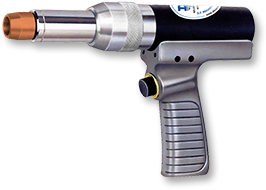
| D/F Water-Cooled Straight or Curved Robotic Torches |
![]()
D/F Water-Cooled 22° & 45° Curved Robotic TorchesThe versatile Water-Cooled Machine Torch models NCC/LRN, HTC/LRN, NCC/N, & HTC/N can be used for a wide range of applications. The machine barrels may be applied to either a remote or direct mount Docking Spools®. With the various angles (22°, 35°, 45°, and 60°) and lengths available (Long Reach 12.5" and Short 5"), a selection may be made to suit individual requirements. MODEL EXPLANATION FEATURES
Example: Require 40786 with 4 Ft. Water-In Hose Assembly - 40786-4 ![]() ![]()
D/F Water-Cooled Straight 8.375" & Long Reach 12.5" Robotic TorchesThe versatile D/F quick change Water-Cooled Robotic Torch models NCM/LRN, HTM/LRN, NCM/N, & HTM/N can be used for a wide range of robotic applications. With the various angles and lengths available, a selection may be made to suit individual robotic requirements.
The composite modular design of the rugged, yet versatile, quick-disconnect model LRN (Long Reach 10" composite water-cooled nozzle) and the model N (short 5" composite water-cooled nozzle) torches allow the user to quickly change the swanneck (gooseneck) or cable assembly while maintaining tool center point, assuring accurate repeatability and continuous precision welding. These D/F robotic torches have a compact, stainless steel, water-cooled nozzle designed specifically to withstand unusually large amounts of reflected heat build-up and prolonged duty cycles. Water circulates internally through the docking spool to the nozzle and the tip, keeping the torches running cooler, and thus the torch and consumables last longer. Mounting is easy with the D/F Universal Robotic Mounting Arm. In the event that a component has to be adjusted or replaced, the docking spool makes this torch entirely serviceable and easy to repair or replace in seconds. These welding assemblies are designated by torch models. The models NCM/LRN & NCM/N (slip-in contact tip) have a current capacity 500 amps in argon shielding. These accommodate slip-in current tips fastened by a collet action nut. The wire diameter range with hard wire is .030"-1/16", cored wire .035"-1/8", and aluminum wire range of .035"-3/32". The torch models HTM/LRN & HTM/N (threaded contact tip) have a current capacity range of up to 650 amperes. Rating will be contingent on the combination of current tip and shielding gas to be used. The model HTM employs threaded CrZr (chromium zirconium copper) current tips and will accommodate .030" - 1/16" hard wire, .035" - 1/8" cored wire and 3/64" - 3/32" aluminum wires. Standard assemblies have torch necks (water-cooled nozzles) that are either straight or bent at 22°, 35°, 45°, 60° or 90°, available in different lengths, and with cable assemblies and replacement docking spool bodies. The LRN & N series torches also share common consumables with the complete D/F product line. Each D/F gun is fully assembled and ready to install. In order to make the installation complete, the code number, wire size, make/model (Lincoln wire feeders, Miller wire feeders, Tweco wire feeders, ESAB wire feeders, & EURO Quick-Disconnect wire feeders), and inlet as needed must be specified when ordering. If special welding tools or accessories other than those listed previously are required, please consult with the factory. Get the right feeder adapter connection to fit your MIG wire feeder. MODEL EXPLANATION FEATURES
Example: Require 40786 with 4 Ft. Water-In Hose Assembly - 40786-4 ![]()
D/F Water-Cooled 35° Curved Robotic TorchesThe versatile Water-Cooled Machine Torch models NCC/LRN & HTC/LRN can be used for a wide range of applications. The machine barrels may be applied to either a remote or direct mount Docking Spools®. With the various angles (22°, 35°, 45°, and 60°) and lengths available (Long Reach 12.5" and Short 5"), a selection may be made to suit individual requirements. MODEL EXPLANATION FEATURES
Example: Require 40786 with 4 Ft. Water-In Hose Assembly - 40786-4 ![]()
D/F Water-Cooled 60° Standard & Long Curved Robotic TorchesThe versatile Water-Cooled Machine Barrel models NCC/LRN & HTC/LRN can be used for a wide range of applications. The machine torches may be applied to either a remote or direct mount Docking Spools®. The 60° model is made to fit special and unique job requirements. MODEL EXPLANATION FEATURES
Example: Require 40786 with 4 Ft. Water-In Hose Assembly - 40786-4 ![]()
D/F Water-Cooled 90° Long & Standard Curved Robotic TorchesThe versatile Water-Cooled Machine Torch models NCC/LRN & HTC/LRN can be used for a wide range of applications. The machine barrels may be applied to either a remote or direct mount Docking Spools®. The 90° model is made to fit special and unique job requirements. MODEL EXPLANATION FEATURES
Example: Require 40786 with 4 Ft. Water-In Hose Assembly - 40786-4 Robotic Welding SystemsRobotic welding is suitable for any welding process designed for automation in that it requires repetitive tasks on similar pieces. Robotic welding also works well when there are welds on more than one axis, or where access to the pieces is difficult. When programmed, robots perform the same welds every time on workpieces of the same dimensions and specifications. In about 80 percent of applications, robotic welding is used with the solid wire GMAW process. Throughout the years, D/F Machine Specialties’ MIG & TIG torches were used exclusively on the following FANUC Robotics System 100 Models - ArcMate 100, ArcMate 100i, ArcMate 100iB, and ArcMate 100iB/6S. The typical power source used with the D/F Torches on the Fanuc robotic cell was a Lincoln Powerwave 450 power supply. QUALITY: Higher quality welds are maintained with the mechanical consistency of the robot. Consistency is provided by the precise movement of the robot arm and torch, as well as the wire feed speed and travel speed. Robotic welding creates a more consistent weld strength and better weld appearance. PRODUCTION COSTS: Robotic Welding reduces productions costs by using fewer welding consumables and producing fewer scrapped parts. RETURN ON INVESTMENT: The ROI for an industrial welding robot usually appears after about 6 months. Increased productivity, decreased labor, and many other benefits of automated welding factor into faster ROI times. PRODUCTIVITY: The repeatability and speed of the robotic welding system provides increased productivity. Robotic welding can produce at a higher rate than human welding, and allow for a more productive workforce. SAFETY: Employers find that they have fewer employee accidents and lower Workers Comp claims when they change to robotic welding. There are two popular types of industrial welding robots, articulating robots and rectilinear robots. Robotics control the movement in each of these robot types by rotating a wrist in space. These two types are defined as follows: 1. Rectilinear robots move in line in any of three axes (X, Y, Z). In addition to linear movement of the robot along axes there is a wrist attached to the robot to allow rotational movement. This creates a robotic working zone that is box shaped. 2. Articulating robots employ arms and rotating joints. These robots move like a human arm with a rotating wrist at the end. This creates an irregularly shaped robotic working zone. Most articulated welding robots feature six axes and function as part of a robotic system or workcell. Robotic welding systems reduce production costs and improve quality with consistency and repeatability. Consistency is provided by the precise movement of the robot arm and torch, as well as the wire feed speed and travel speed. The repeatability of the welding robotic system provides increased productivity. To create a successful robotic welding system, you need an integrator who can properly design a program that integrates the parts to be welded and the robotic cell and tooling. Robotic welding is simpler than one might think, but it requires precise measurements and an understanding of parameters of the equipment. It is important to team with an integrator with the experience and customer service demanded by your robotic needs. Benefits of Robotic Welding:
Things to consider before beginning a new robotic welding project:
Benefits:
Features:
Options:
Note: ARC Mate is a registered Trademark of FANUC LTD. FANUC Ferris Wheel System - The FANUC Ferris Wheel Workcell is designed to save space and enhance operator safety. FANUC Gantry System - A gantry robot system mounts a robot arm on an overhead track, creating a horizontal plane that the robot can travel and extending the work envelope. FANUC Manual Turntable System - A FANUC workcell with a manual turntable is an ideal solution for applications that require loading and unloading parts while the robot is in operation. FANUC Stationary Table System - FANUC robots offer excellent ROI in welding and handling applications. Realize incredible savings with a FANUC turnkey workcell that includes a single or dual stationary work table. FANUC Track System - The Dual FANUC Track System allows for nearly 63 feet of travel along a servo controlled track to accommodate applications with large parts and multiple processes. FANUC Turntable System - Order a workcell that fits your needs! Available in any size, this workcell pairs a 180 degree table with one or two FANUC robot arms for maximum productivity. Shop Gains Productive Edge with Robotic Welding F.R. Custom Metal Fabricating Ltd. made a sound investment in the future with the recent purchase of its first robotic welding cell. Faced with a contract to produce a large volume of pallet truck handles, the fabricating shop found it increasingly difficult to maintain the skilled workforce of welders needed to produce consistent, high quality parts at the necessary volume. By adding a two-station Lincoln Electric automated welding system with D/F Machine Specialties torches, the firm is now able to meet production and quality goals without trying to find employees willing to work overtime.
As with most manufacturing firms throughout North America, F.R. was finding it increasingly difficult to hire the skilled workers needed to maintain the quality and volume of its production. And with today's busy lifestyle, employees were less willing to work long overtime hours to keep up with the demand. After meeting with representatives of The Lincoln Electric Company's Automated Systems Group (ASG), Alfred and Bill Nonnewitz concluded that the benefits of automating the handle-welding operation would be worth the investment. The result is a complete two-station work cell that incorporates a six-axis Fanuc ARC Mate™100i robot equipped with a SYSTEM R-J3™ controller, a Lincoln Power Wave® 450 power source, and a D/F Machine Specialties 22 degree LRN water-cooled torch (D/F #40785-4). Safety was built into the welding cell with the addition of safety zone rings (limit switches) that prevent the robot and welding torch from going to the station where the operator is working on the next setup until the area is cleared. In addition, each station has a safety mat that prevents the robot from coming to that station if the operator is standing on the mat. Further safety protection is provided by a breakaway nozzle that minimizes damage in case the torch hits any part of the workstation or the parts being welded. All components are mild steel, with the handle and brackets being 16 gauge and the tube being 14 gauge. Welds are made with .035" diameter Lincoln SuperArc® L-56™ (AWS ER70S-6) electrode, which includes extra deoxidizers that provide cleaning action and improve weld quality. Since the handles are used to move pallet trucks that weigh up to 5000 lbs., weld integrity is critical to meeting the stresses they must withstand. All welds are fillets, but the welds that join the round handle to the square tube are especially critical. Bill Nonnewitz explains, "The welding power source is capable of making a full regulated controlled weld without spatter or burn-through. Because we only have 1/16" on a side, the welds can't extend out very much. They have to be good, and the penetration has to be consistent." Jim Grant explains that the entire workstation is modular and can be moved with a forklift. "It's essentially a plug-and-play robot that was placed on the floor as a complete unit, pre-programmed for the parts they make. Everything is mounted on a platform that keeps the units in proper relationship to one another and allows the cell to be moved easily to another location if needed." The Lincoln PowerWave® 450 is a sophisticated power source that gives the company significant advantages, with cost savings that are expected to more than offset a slightly higher initial investment. First is the unit's capability for Pulsed MIG welding, an advanced welding mode that combines the best qualities of all other metal transfer modes without their disadvantages. Its lower heat input prevents burn-through on thin metals. Spatter and fume are reduced as well, which improves the working environment and reduces costs. Since only one wire size is required, wire and gas costs are also lower, and the process delivers higher deposition rates than other processes, so productivity is greater. In addition, the power source can be updated easily with new software, an important advantage that protects the company's investment. The Fanuc ARC Mate™100i robot is designed with integral utilities to improve reliability and setup time. The wire feed motor cable, gas line and air line are all inside the robot arm. Its high motion speeds help improve productivity, and advanced servo-control features allow faster and smoother point-to-point motion. The FANUC Robotics System R-J3 controller is completely integrated with the robot itself, which allows flexible work cell layout and easy installation. It utilizes the most advanced software with features that include welding restart, scratch start, and on-the-fly weld adjustment. Mirror image utility allows the programmer to shift an existing program and also to invert it, which is extremely useful with F.R. Custom Metal's two-station mirror-image cell. The program also allows starting and stopping the programmed welding sequence from the Teach Pendant, which features commands in English for ease of use. While no comparative figures were kept, the improvements in product quality and productivity have been significant since the company added the robotic cell, and the labor shortages it experienced earlier have been minimized. Bill Nonnewitz says that, since installing the robotic system a few months ago, the company has already seen significant savings, both in reduced overtime costs and in rework and scrap losses. |
|||||||||||||||||||||||||||||||||||||||||||||||||||||||||||||||||||||||||||||||||||||||||||||||||||||||||||||||||||||||||||||||||||||||||||||||||||||||||||||||||||||||||||||||||||||||||||||||||||||||||||||||||||||||||||||||||||||||||||||||||||||||||||||||||||||||||||||||||||||||||||||||||||||||||||||||||||||||||||||||||||||||||||||||||||||||||||||||||||||||||||


F.R., a custom fabricator founded 28 years ago by its President, Alfred Nonnewitz, traditionally has specialized in lower volume, higher quality fabrications, particularly those involving tubular components. For the last three or four years, the company has been producing pallet truck handles on a contract that calls for increasingly higher volumes, now generally between 700 and 1,000 parts per week, according to Bill Nonnewitz, the founder's son.
